

The definition of bioeconomy has continued to evolve over the past few years, and the discussion around it is still developing as more stakeholders attempt to define it. The Indonesian government has already identified bioeconomy as one of the pillars of economic transformation in the 2025–2045 National Long-Term Development Plan (RPJPN). Despite the lack of a universally accepted definition, capital continues to flow into the sector. Interestingly, very few investors funding these businesses actually describe themselves as “bioeconomy investors.”
This is what makes the landscape seem somewhat unusual at first glance. Coconut processing companies, platforms that connect fishers directly with buyers, and traditional herbal medicine producers are all grouped under the same investment category. The question is, who is willing to invest in a combination of sectors that, on paper, appear to have little in common?
The report Bioeconomy in Indonesia: Private Investor Appetite and Preferences, published by the INTRA Institute, the knowledge generator of Avantierra (previously ANGIN Foundation), attempts to answer that question. The study covers companies based in Indonesia as well as the broader Southeast Asian region. It identified 216 companies with a combined funding value of US$11.76 billion. Rather than focusing only on the amount of capital invested, the report also examines who provides the funding and how they evaluate investment opportunities.
Not All Investors Think the Same Way
Before discussing the major investors, it is important to understand that investors are not a uniform group. The report classifies them into four distinct types, each with very different characteristics.
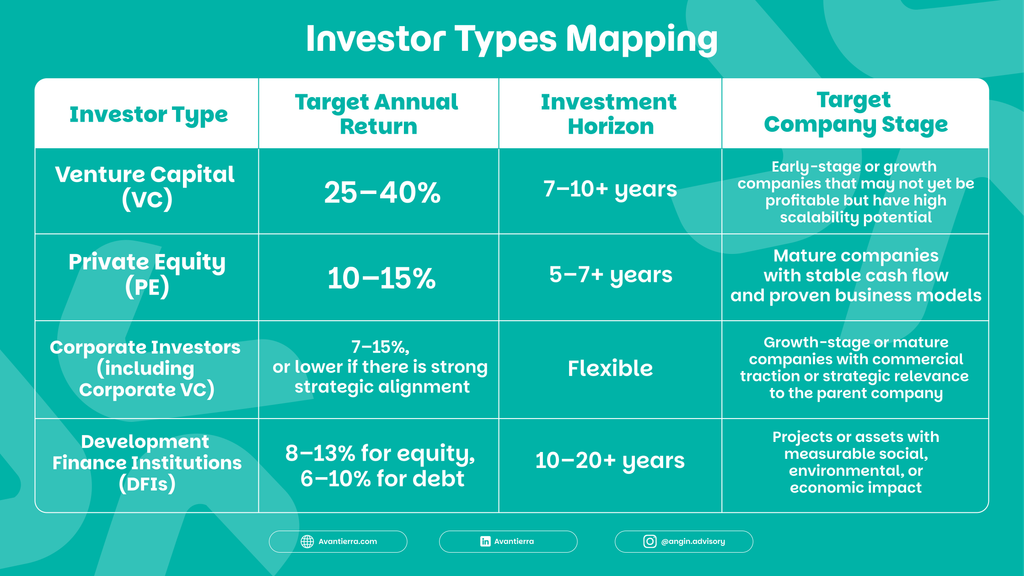
With this framework in mind, it becomes much easier to understand why certain investors repeatedly appear in Southeast Asia’s bioeconomy investment landscape.
Who Invests in Bioeconomy Most Frequently?

The report ranks investors in two different ways, and each ranking tells a different story. The first looks at which investors appear most often, measured by the number of bioeconomy companies in their portfolios.
By this measure, 500 Global and Antler are the most active, each holding stakes in 11 bioeconomy companies. 500 Global manages approximately US$2.3 billion in assets, while Antler manages about US$72 million in assets under management (AUM) dedicated to its Southeast Asia fund. They are followed by 144 Ventures with eight portfolio companies, while East Ventures and Alpha JWC Ventures each hold stakes in seven companies, with approximately US$1.5 billion and US$650 million in AUM, respectively.
Other investors on the list include SPACE-F, Wavemaker Impact, Startup Studio Indonesia, Openspace Capital, Seeds Capital, MDI Ventures, Insignia Ventures Partners, Intudo Ventures, and TNB Aura. Of the 15 most active investors, the majority are based in Singapore.
The second ranking takes a different perspective. Instead of counting bioeconomy portfolio companies, it ranks investors by the total number of global investments they have made across all sectors while also participating in Southeast Asia’s largest bioeconomy deals.
In this ranking, 500 Global again leads with 3,177 global investments, followed by Brazil’s Bossa Invest with 2,222, India’s Peak XV Partners with 779, Japan’s Global Brain Corporation with 742, Indonesia’s East Ventures with 676, Singapore’s Temasek Holdings with 612, the United States’ Kohlberg Kravis Roberts (KKR) with 428, the United States’ Endeavor Catalyst with 395, Flourish Ventures with 173, Taiwan’s AppWorks with 150, Singapore’s Golden Gate Ventures with 134, and Indonesia’s Alpha JWC Ventures with 117.
The report also highlights an important point. Not every organization on this list is an equity investor. Some are debt providers rather than equity investors.
When Investors See the Same Market Differently
These figures do not fully answer the more interesting question of how investors actually evaluate opportunities in the bioeconomy. To address this, the report complements its quantitative analysis with interviews with investors actively involved in the sector, with two presented as case studies as they illustrate markedly different investment approaches.
The first is The Mills Fabrica, the innovation and investment arm of Nan Fung Group, one of Hong Kong’s oldest and largest textile conglomerates. As a corporate venture capital investor, it focuses on early-stage companies in agrifood and textile innovation, with investment tickets ranging from US$200,000 to US$3 million.
Although The Mills Fabrica actively invests in sectors closely associated with the bioeconomy, it does not explicitly identify itself as a bioeconomy investor. Only after becoming familiar with the concept did the firm begin exploring where the bioeconomy overlaps with its existing investment mandate. For the firm, alignment with core themes such as sustainable materials and agrifood innovation is more important than the label itself.
The second case study is Stewart Investors, which has a very different identity. The UK-based investment management firm oversees approximately US$15 billion to US$20 billion in assets and is known for its long-term, sustainability-oriented investment philosophy.
Its investment screening process is also far more systematic. Stewart Investors uses assessment tools such as Sustainalytics and RepRisk for qualitative evaluations that incorporate local media reports and NGO findings. It also applies an exclusion list that rules out extractive industries, gambling, tobacco, and companies that continue to rely on fossil fuels without credible emissions reduction commitments.
One of its portfolio companies, PT Industri Jamu dan Farmasi Sido Muncul Tbk, demonstrates how this philosophy is applied in practice. The Indonesian herbal medicine and healthcare company is considered a good fit with Stewart Investors’ approach because of its focus on traditional wellness products, locally sourced raw materials, and community employment.
The Group That Still Keeps Its Distance

While venture capital firms and institutional investors have been actively exploring the bioeconomy, Asian family offices occupy a very different position. The report cites a survey by the Sustainable Finance Initiative (SFi), conducted in late 2024 among family offices across Asia. The findings reveal a consistent pattern. Although there is genuine interest in impact investing, relatively little capital has flowed into sectors such as the bioeconomy.
In terms of portfolio allocation, more than a quarter (26 percent) of the surveyed family offices allocated at least half of their portfolios to impact or ESG investments, while another 23 percent allocated at least one-tenth of their portfolios to these areas. These are not insignificant figures. However, the same survey found that Asian family offices generally separate philanthropic activities from their core investment portfolios. This separation ultimately limits their exposure to sectors such as the bioeconomy compared with other types of investors.
When asked about their preferred impact investment themes, Food and Agriculture ranked highest with a score of 5.8 out of 10, followed by Circularity and Innovative Materials at 5.5, and Nature-Based Solutions and Biodiversity at 5.2.
Their investment approaches are also divided into two broad strategies. Around 41 percent adopt a total portfolio approach, integrating sustainability considerations across their entire portfolios. Meanwhile, 40 percent prefer opportunistic investing, focusing only on specific transactions with high-impact potential.
The Right Fit Matters More Than the Right Name
The report makes it pretty clear what international sustainability investors are thinking. They’re open to investing in the bioeconomy, but only if the opportunity lines up with the investment mandates and criteria they’ve already set. This might sound simple, but it explains almost all of the patterns discussed in this article.
Investors aren’t waiting for the “bioeconomy” sector to mature before they enter the market. They’re on the lookout for opportunities that speak to their strengths, whether that’s agrifood, sustainable materials, or technology-enabled supply chains. Attracting more capital to Indonesia’s bioeconomy means translating existing opportunities into investment frameworks investors already understand.
This article summarizes some of the main points from the report Bioeconomy in Indonesia: Private Investor Appetite and Preferences, which was published by the INTRA Institute in December 2025. The full report provides a more detailed comparison of investor types, insights from interviews with investors active in the sector, and policy recommendations for strengthening Indonesia’s bioeconomy ecosystem. Check out the full report on the Avantierra (previously ANGIN Foundation) website.